Sunday, April 17, 2016

No Place to Be Somebody by Charles Gordone

-->
Sammie Wayne IV and Meghan Renee Lang - Photo: Niketa Caleme Harris


By Joe Straw

“The theatre, he contended, served for railing at prejudices, and, beneath a mask of pleasure, taught virtue.” – Gustave Flaubert, – Madame Bovary

I’ve heard this from time to time.  You are the company you keep. It’s cliché – and kind of true – well, something that makes sense.  And it fits with the play No Place to Be Somebody. Because, if you wanted to be somebody then Johnny’s Bar is not the place you want to be. And, almost everybody wants to be somebody.  Don’t they?

The Pulitzer Prize winning play, No Place to Be Somebody by Charles Gordone and directed by Ben Guillory, is presented by the Robey Theatre Company at the Los Angeles Theatre Center through May 8th, 2016.

No Place to be Somebody is a thoroughly gratifying show.  Finesse and dedicated actors work their craft to bring light to the Robey stage. This is a show about extremely unusual characters that have a found a niche.  But they are itching for more out of life than hanging around a bar with endemic friends with less than stellar reputations.  

The lights are lonely dimmed as Gabriel (Leith Burke) sits at a table in Johnny’s bar, front and center, pulls out a joint, and lights up. He taps away at the Royal typewriter, like he’s a writer or something, which he ain’t, cause if he was he wouldn’t be there. It’s 1969, late at night, and you can’t hear the turmoil of the war demonstrations or the Civil Rights marches in the bar, down the street, or across the Brooklyn Bridge. He is just a man getting his thoughts together.

Gabriel’s now got to introduce himself and say why he is here.

“Don’t want you goin’ out’a here with the idea what you see happenin’ is all a figment of my grassy imagination. ‘Cause it ain’t!”  - Gabriel

Shanty (Ben Landmesser), laboring, an employee of Johnny’s bar, carries the drumsticks in his back pocket pulling them out to practice on everything that’s drumable, the jukebox, the chairs, and the bar.  Things along the bar have little “beat marks” on them something Johnny (Sammie Wayne IV) doesn’t like too much and Johnny would rather have him cleaning up than pounding on things in his bar.  

Yes, Shanty said he done it.  Played with some of the biggest jazz names.  Those names are figments of that dream-making machine inside Shanty’s head.   

“One if these days I’m gonna have me a boss set’a drums. - Shanty

(Why anyone would call his kid, Shanty, is beyond me. His parents might as well call him poor white trash from the get-go just to cement a life that moves in that direction.)

Evie (Saadiqa Kamille) and Dee (Allison Blaize) enter the bar with stories to tell about a night gone wrong, specially with some Texas john using the “N” word ‘til he lost breath.  Well, actually it was Evie who got tired of it all.  It was she who bashed his head open with that lamp – the lamp that a happy customer, a Senator, gave them.  And he brought it all the way from Russia, just for these two darlings.   

“Sure hated to lose that lamp.” – Evie

Johnny don’t like the girls scaring away the customers.  And he’s always into their stuff rummaging through their purse for money, until he finds the baby shoes in Dee’s mess, paraphernalia that he immediately dumps into the trash: that just about pushed Dee’s last button.

Breaking up matters, Cora (Kacie Rogers) runs in to get out of the rain and to see her boyfriend, Shanty.  And right away, Cora and Evie get into it with Evie pulling a razor. Johnny, emotionally elevated, wants no blood in his bar and positions himself betwixt the two.  

Martini poured, Cora sits at the bar, tells Johnny that she was willing to help him after he got out of reform school but Sweets (Hawthorne James) got to him first and ruined him.

Melvin (Matt Jennings), fresh out of dance class, hurries in but is late for work – couldn’t get a cab – white folks couldn’t get one neither in this weather. Johnny says he outta get paid for throwing around his tukus for free. 

And happy as a clam, Gabe steps in and has them pour him a drink.  He’s all exultant because of his audition with hundreds of his closest friends - for a musical about slavery.

Johnny just shakes his head, pulls out some money, and throws it on the table, trying to get him to join his team.

Gabe’s not havin’ any of it.

“Okay, Hollywood!  Keep knockin’ on doors with yo’ jeans at half-mast!  Sellin’ yo’-self like some cheap-ass whore!  If I know one thing about you, you ain’t that good’a actor!  Whitey knows right away you can’t even stan’ to look at him!” – Johnny

Time passes, days and nights, weeks like yesterdays.

Shanty and Cora are two different sides of the coin, they can hardly communicate - each off in their own world, being nobodies and having no one, having a discussion, smokin’ weed, talkin’ about their previous mates.  She’s thinking this white man in Johnny’s bar would be good for her.  He’s thinkin’ that a white woman is someone he should take a broomstick to.  Neither one can see that the other’s not someone to establish a long-term relation with.

“I’d like a daiquiri, please – “ – Mary Lou Bolton

Mary Lou (Meghan Lang), straight off the streets demanding Civil Rights for union workers, walks in with her high fallutin’ self, wanting to make something out of this nothing bar, Johnny’s Bar. Her friend, Ellen (also Allison Blaize), wants her to get out of there and wonders why she’s always doing what she does.   

Johnny has taken a liking to Mary Lou, straight out of Elmira College, and he gives her a quick lesson, something to study while he’s at it and this scares her off for the time being.  

L - R Gianluca Malacrino, Hawthorne James, Sammie Wayne IV - Photo: Niketa Caleme HarrisL


But, you know, Johnny is waiting on Sweets, waiting for Sweets to get out of prison so they can claim what’s rightfully theirs, the streets, but when Sweets arrive it’s one more story in this place to be somebody, or not.  

This is another strong Robey outing and Ben Guillory, the director, is responsible for the fine details on stage, the intangibles that give the characters added dimensions that is projected out beyond the fourth wall. The characters lives stay with you long after the lights have dimmed.

There are a few things that need addressing, a moment, and objective but for the most part, No Place to Be Somebody is as smooth as the best drink you every put into our mouth and tasty too.  And, it will only get better with age and more performances under their belt.  

Allison Blaize does a fine job as Dee, a hustler, who works for and is in love in the Johnny. Dee, try as she might to have solid relationship, knows she is in a bad situation.  Interesting thing about the baby shoes is that she probably wants one and I think she is moving in this direction.  But she seems to lose sight of the objective that could carry her through to the end.  Still, some wonderful work.

Leith Burke is Gabe Gabriel, the poet, writer, actor, a man of mixed race, is on a mission with no place to go.   The writing’s not working, the acting work is dismal, and hanging around the bar is just too much for his sensibilities.  Near the end he is certainly way over his head and probably wishes he had never met Johnny. Burke rises to the occasion in this play. But, is the character’s objective to absorb the inner workings of life at the bar?  If so, why isn’t he taking notes?

Ray Dennis plays Machine Dog, a figment of Gabe’s imagination.  I didn’t get the wrench and one day I will get this role, the objective, and his reason for being.

Hawthorn James is delightful as Sweets Crane, a huge man, sickly, and a man who loves macaroni salad. In all seriousness, there is a lot of good work going on here.  And the humorous moments in his portrayal along with his dangerous side adds up to a complete character.  James’ craft is his road traveled, mysterious, seethingly treacherous and at times provocative. All that makes for a wonderful performance.

Matt Jennings plays Melvin Smeltz, a dancer with a nice body but little dancing skills.  He is lost in the studio and lost as a short order cook that can barely peel a potato. (Jennings has to work on peeling a potato.) Also, it is not clear if the character knows the difference between a sautés, jeté, cabrioles, or assembles, as the dance moves seem less than exquisite. Why is he there in the bar? It’s hard to tell.  Jennings has to find a reason to be there.  It’s not the pay, nor the girls, so what else could it be? There has to be more in his relationship with Johnny.

Saadiqa Kamille is quite ideal in the role of Evie Ames a strong woman who wants more than what Johnny has to offer.  She’s fed up with the life and wants to move on. Kamille’s performance is fantastic, oh yes it is!

Ben Landmesser has some really good moments as Shanty Mulligan, an Irish mutt of a man with not much talent as a drummer; it’s just a dream, because people have got to have dreams. Still, that doesn’t stop him from carrying around the sticks to practice every waking moment.  He cuts himself peeling a lemon, ruining his drumming fingers, but oddly that didn’t play into that particular scene. Still, there were a lot of nice moments coming from this actor. Landmesser has a very strong stage presence, a very strong craft, and does well in the role.

Meghan Lang does enormously well as Mary Lou Boulton, a college woman, who wants to taste the racier side of life.  Born to trouble, Mary Lou wants to get more out of her existence and will do anything to get what she wants.  Lang gives a tantalizing performance that, once in costume, fits with the time and the place. Lang is bold and baiting in one swell swoop.

Gianluca Malacrino is also impressive as Mike Maffucci a small time hood who wants to take over, no matter what it takes. The moment with the macaroni salad is filled with so much life, a lot of fun, and hits with a very strong truth that one thoroughly enjoys in theatre.

Monty Montgomery plays Sergeant Cappaletti and has a face that you think you’ve seen on TV thousands of times.  In other words, it is a good face for TV.  Cappaletti is a muscle man and uses his girth, badge, and gun to suppress dissention.

Suave, sophisticated, and sleazy is what you would describe as Judge Bolton played by Darrell Philip a man who gets what he wants when he wants it. A man whose voice projects barely above a whisper, and with slightest manipulation of his finger he moves man and machine to his desired effect. He is dastardly, in a very nice job.

Kacie Rogers plays Cora Beasley as a woman who would like to have things her way but misses the signals that would suggest that she should stay away from bar she frequents right down to the man she has chosen. But maybe there’s more to be had here in the character and in the way she’s not picking up the signals.  What kind of person would let herself be completely abused without something not clicking?  Does compassionate love override those signals?

Seeing Sammie Wayne IV in various roles at the Robey Theatre this is probably his best performance to date as Johnny Williams. Johnny has a need for people men and women coming around the bar.  There is a hint that Johnny is bisexual because of his interactions with people who frequent the bar. Handing out money to men, and molesting women.  It is a very interesting performance, one that again has Wayne searching for the words (maybe that is an affectation) and losing sight of the objective from time to time. Still, it is a very good performance.  

Charles Gordone’s play is significant in the way it opened a visionary door.  It is the verbal interaction of whites and African Americans, in rustic volubility.  The language is harsh, the physical interaction intense, and the crimes committed are not from one segment of the population. In the overall play, the beauty is not only found in the words from the sententious poet, but it is found in the body of the work, and that is what carries the night.


Tom Meleck, Scenic Design, has created an impressive set for which the actors can create their magic.  It is magical, fully functional, and a place one would find in 1969 New York.

Michael D. Ricks’ wonderful Lighting Design highlights the beautiful set.

Naila Aladdin Sanders is responsible for the glorious Costume Design of the characters. Each provided another element of character, a visual accouterment to an actor wanting to perfectly define the character.  Marvelous work!

Other members of the crew are as follows:

Tamir Elbassir – Production Stage Manager
Melvin Ishmael Johnson – Assistant Stage Manager/Veteran Intern/Prop Master
Julio Hanson – Music/Sound Design
Kiana Lyons – Assistant Stage Manager/Prop Master
Jason Mimms – Graphic Design
Niketa Calame-Harris – Production Photographer
Philip Sokoloff – Publicist
Judith Bowman – Development Director
Chris Carneli – Webmaster

Run! Run! Run! And take someone who devours the word change. 

RESERVATIONS: (866) 811-4111.
ONLINE TICKETING: www.thelatc.org

Monday, April 11, 2016

La Olla by Evelina Fernández

-->
Sal Lopez - Photo: Grettel Cortes


By Joe Straw

He said the seats had my name on them and that they would be pre-seating me.  

Well, I went in – turned a few circles, spied a few names, mostly theatrical celebrities on this opening night – then I got to the stage.  When I turned around I noticed three or four hundred seats, all with names on them.

Rather than reading “War and Peace” I asked the usher, “Where are my seats?”

“Maybe you can sit with that lonely man over there – the one with the press packet.”

He looked none too happy, alone.

I trudged over to his area, far stage left, looked at the stage, and I noticed a huge wall separating me from viewing most of stage right. 

Watching, from this vantage point, could be problematic. If I were going to make a move it would have to be now.

Suddenly, patrons blocked me in, moments passed, and by this time the other seats were being filled. Still, I was not resigned to stay in my seat.  Standing, I tried to figure out if any remaining white piece of paper – that I couldn’t read – had my name on it.  

But, as the lights dimmed, I realized, I had great seats, as is every seat in the house – Narrator

Yee Eun Nam - Set Designer
 
The wall in the middle of the set was a huge symbolic vertical sacrificial stone that served a purpose.  Ancient smoke encircled the ruins and a pleasant odor drift out into the theatre. I was glad to see the same stonewall, in question, was not a permanent fixture. All of this was beautifully designed by Set & Projection Designer Yee Eun Nam.

The Latino Theater Company present the World Premiere of La Olla written by Evelina Fernández and directed by José Luis Valenzuela, adapted from the Roman Comedy The Pot by Plautus through April 24, 2016 at the Los Angeles Theatre Center

La Olla is a very funny comedy with solid performance by a remarkable cast, some more remarkable than others. This is all said in jest, as the whole show is a solid outing for the Latino Theater Company and almost something for the whole adult family.

One of the interesting things about José Luis Valenzuela’s direction is the manner in which he introduces the characters, at first it is a slow dance, measured on and off stage, each in a specific character, moving, watching each other, some garbed in spy coats - ala Spy vs. Spy – all involved with their specific trait. The actors leave the stage, move upstage (backstage at La Olla) and get undress, appearing almost naked in unitards, changing from one costume into another.  The impression, in a myriad of ideas, is that the characters will be frolicking in various roles. And then, during the course of the play, Valenzuela has them coming in and out like the Marx Brothers, or The Three Stooges, through every door, beyond the walls, in and out, in a tumultuous display of non-stop hilarity.  

La Olla means pot, or the pot. La Olla is an adaptation from Roman playwright Titus Maccius Plautus’ Aulularia. 

(Unbeknownst to Cesar and his knife carrying lot, the Romans were very funny, yes they were.)

La Olla is also a nightclub for which Sobersides (Gástulo Guerra) is the master of ceremonies.  Sobersides is a mystical person of sorts who lets us in on the characters in the show, their history, and unimpressive talent, and he also introduces the cabaret attendees, to the performing acts.

One such act is La Diva (Esperanza America) a ne’er-do-well who is at the end of her professional career.  Finishing her career now at this once promising but now rundown 1950’s cabaret club, La Olla.

One night, after her performance, La Diva is rolling around in a fit, in her large frame, on the floor. La Diva is ready to be institutionalized.  She is replaced by Phaedria (also Esperanza America) who steps in and, at first, is not sounding good but then warms up to the audience and suddenly becomes the up and coming star.

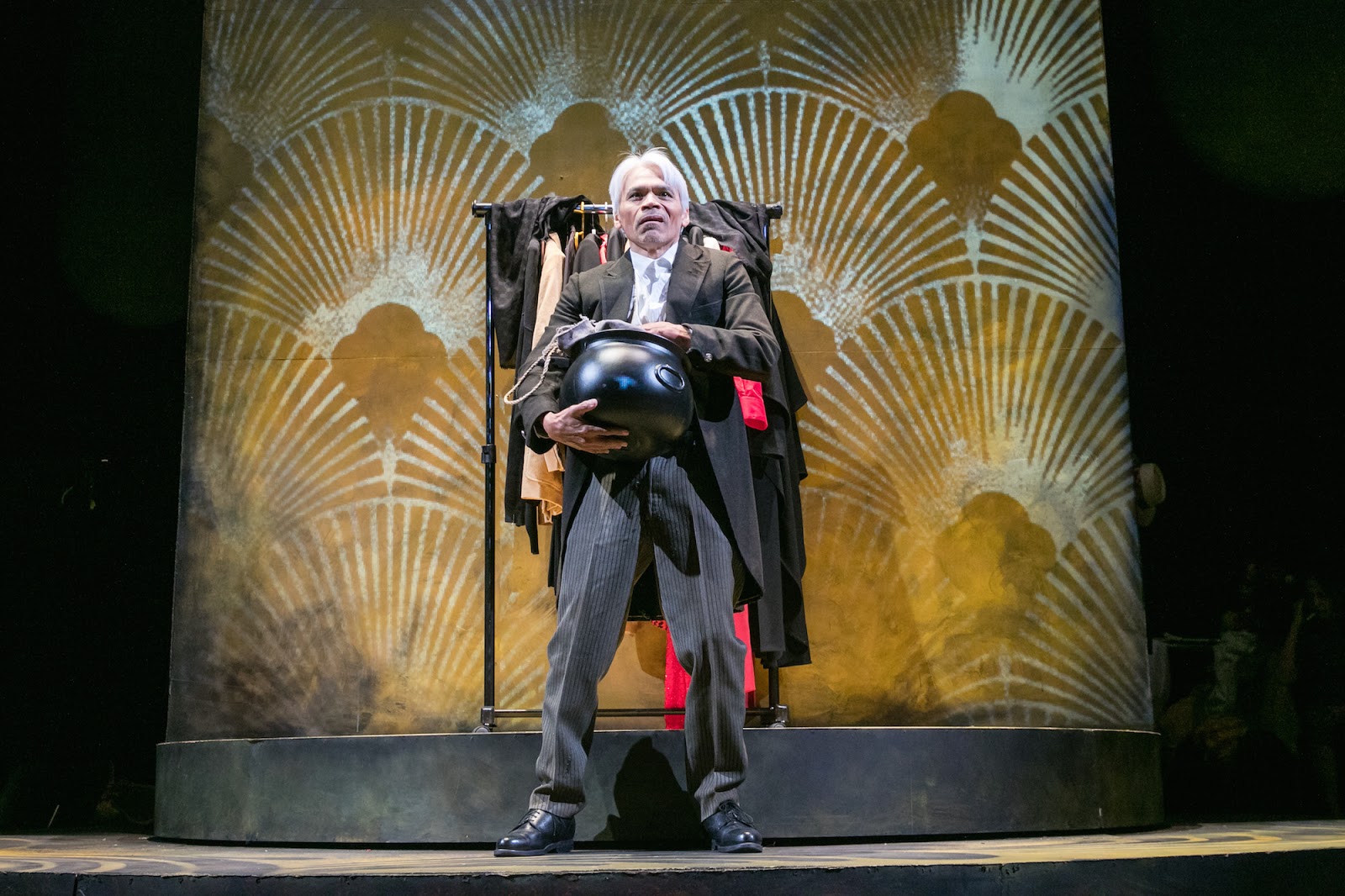
While this is going on three nefarious men Eel (Sam Glozari), Mack (Fidel Gomez), and Chon (Xavi Moreno) have robbed someone and are running from the authorities.  They hop into the La Olla nightclub and stash the money in one pot, in a dressing room filled with the many pots.

Eulclio (Sal Lopez) discovers the money and hides it, telling his wife Staphyla (Evelina Fernández) not to let anyone in to their dressing room where the money resides. Of course, he doesn’t tell her why.

“You asshole.” - Staphyla

Megadorus (Geoffrey Rivas), the sexually ambiguous nightclub owner, sees the value of the up and coming star, Phaedria, and wants to marry her. A serious discussion with his confidant, sister, or lover Eunomia (Xavi Moreno) confirms the choice of marriage.

But Phaedria has been secretly hiding her pregnancy and has various reasons why she doesn’t want to be with Megadorus. First, she is in love with Lyconides (Sam Golzari), the father of her child, and second, Megadorus is twice her age, gay, and is badly attired. And, as a side note, Megadorus is Lyconides’ Uncle.   

There’s another problem: the not-so-smart Eulclio, with gold carefully stashed away, has promised his daughter’s hand in marriage to Megadorus.  Megadorus has money.  Why should Eulclio spend his pot of gold for his daughter’s marriage?

Truth be told, Eulclio gets a little wacky about the money, imagining that others are trying to steal his newfound money. One thing’s for sure, he is not giving it back.


Esperanza America and Sam Golzari - Photo: Grettel Cortes

Esperanza America is outstanding, and totally unrecognizable, as La Diva (in wonderful costumes by Naila Aladdin-Sanders). America is extremely funny as Phaedria a ne’er-do-well who has done well at least once.  Gangly, pregnant, and walking nimbly on two crooked feet Phaedria becomes the beautiful diva on the strength of her voice. America is wonderful in characters and these roles are one performance not to miss.

Evelina Fernández plays Staphyla and actor, wife and nightclub performer who is fed up with everyone and this life. She plays through the necessities of life on stage with a forgotten cigarette between her lips as she performs by rote.  One has seen this character before but it never gets tiring.

Sam Golzari is also impressive as Lyconides, Sam and Eel. Golzari has a wonderful cabaret voice and has a very funny presence on stage. The sight gag on stage for one of the last scenes plays to perfection.

Fidel Gomez is fine as St. Genesius, Strobilus and Mack. One is not really sure about the accent that Gomez uses as Mack, or the region for which the voice serves a purpose in the play.  It gave him another character, vocally, tough guy, but how does this work in the context of the play?  That aside, Gomez is very funny.

Cástulo Guerra - Photo: Grettel Cortes


Cástulo Guerra is extremely impressive as Sobersides.  His choices were clear, his motives defined, and the emotional life was well beyond remarkable. This is one actor that productions should find a space for. Wow!  Excellent work! Don’t miss his performance!

Sal Lopez is Euclio and brings forth another funny performance. Eculio is a man, husband, and father who is none too bright, but smart enough to know that he is in a lot of trouble. (But, seriously, we’ve got to do something about the sweeping up on stage.  Sweep until you finish, have a dustpan, sweep it under the rug, offstage into the audience, and/or dispose the waste, in character of course, but just, finish.) Lopez does well with eyes scrunched barking his way to reach his objective.  His movements are precise and the gold is real.

Xavi Moreno is an incredible actor.  His characters are well defined, and very peculiar in an astonishing and very interesting way. His physical manner on stage for each character is flawless and this is also a performance not to miss.  He is seen as Eunomia, Hank, and Chon.

Geoffrey Rivas is splendid as Megadorus (sounds like a dinosaur), a gay man who convinces himself the show would be better off if he married to the up and coming star.  Rivas performance reminds one of La Cage aux Folles and is very funny and charming in many ways.  

Evelina Fernández’s work as the writer gets better with each new play. The dialogue is snappy, the situations are flamboyant, and underneath it all has a mystical quality, a time in space focused and personified.  You can’t really write this off as an adaptation: Aulularia, is a work lost which has not been completely found – those funny Romans and their storage capabilities. This is Fernández at her finest.   

Other members of the crew are as follows:

Urbanie Lucero – Choreographer & Movement Coordinator
Pablo Santiago – Lights & Projection Design
John Zalewski – Sound Design – The sound elements were extremely impressive and add another layer to the show.  One is always fascinated by Zalewski’s work and the manner in which the work progresses the show.  
Naila Aladdin-Sanders – Costume Design – While the time frame is ambigious, the costumes kept the players rooted in the same period.  Aladdin-Sanders’ work provides just one more layer to the overall show.
Camille Villanueva – Puppet Design – Loved the puppets!
Rosino Serrano – Musical Director – They are in a cabaret and the music worked wonderfully.
Lauren Hadnot – Assistant Stage Manager
Henry “Heno” Fernandez – Stage Manager

Run! Run! Run!  And take someone who loves Buster Keaton!
Reservations: (866) 811-4111.
Online Ticketing: www.thelatc.org


Sunday, April 10, 2016

Lyrics From Lockdown by Bryonn Bain


Bryonn Bain


By Joe Straw

Theatre can’t get anymore beautiful than this, so indulge me for breaking a few rules. – Narrator

Bryonn (pronounced Bree on) has a lovely voice, smooth, soothing to the core, a voice to meditate to, with, and by.  His mellifluous declaration filled the spacious UCLA Freud Playhouse Theatre with lyrics and songs on the night of March 4th, 2016.

And when Bryonn’s voice dies and the stark black and white pictures fade, the message lingers.  It is a voice worn from repetition but strong in its resolve that, although the battle against injustice may make one weary, is nevertheless a battle that must be won.  

“Marcus Garvey Boulevard” is a street in the Bedford-Stuyvesant neighborhood of Brooklyn and also a song of the same title.  The voice that Bryonn sings, while taking a stand, is lonely, crying out for righteousness on the road against racism, hate, and oppression.    The lyrics and music would lift any soul from the emotional scars of the past.  Naytheless, from him, the tone is sincere and his fight is justified.  

In the artwork projected on screen, a light pole stands, casting no light on to a darkened street, slightly relieving the fear of being alone on Marcus Garvey Boulevard and alone in the dark. And in the image, the creator of the painting, appears to be etching the line to make the apartment building stretch city blocks, and yet the light is not resilient, the building fades in the dark, the streets are opaque, the sidewalk uneven, and of the tune of a softly sung song about a body on Marcus Garvey Boulevard.

What body?  I’m not quite sure.

But for now, he sits solemnly in a jail cell beyond the rising scrim. Bryonn recreates a life, his life from the past now standing alone, in black, wearing a uniform, this hoodie, and white sneakers. 

Byronn is short, buffed, too much time in the gym, or not enough, depending on how one looks at these things.  But his voice is clear, head protruding toward the sky like a repressed songbird, but warning you about life, that for some is not so smooth – all in vocalized poetry.   

Images, songs, and videos emanates from all directions – the first arrest, dismissed, and then trouble, big trouble. After a 60 Minutes interview – with Mike Wallace, there is retribution.  It is a concerted effort that has no end point in an effort to discredit his life. He is a man from Harvard with a voice that others think must be silenced.    

The activism is real. And, theatre by definition is activism.

What night is so right and so cleverly defined?

Gina Belafonte, the director, sends us out into the night, absorbing the visuals and peacefully humming the songs.  The message is not one of anger but a measured speak, a peaceful parting of how much we have to learn.  Belafonte chooses a direction that speaks not of violence, but in a calm persuasive tone to make change.   

The musicians added to the brilliant night.  They were Aaron Shaw, Saxophone and Flute, Click, Beatbox and Chains, Isaiah Gage, Cello and Beatbox, and Jachary Beats, Bass and Guitar.

Stevie Wonder was there on this night, absorbing what they offered.  And Rob Reiner was there as well.     

The art projected on screen is real, compliments of Sankofa.org – “a social justice organization that enlists the support of today’s most celebrated artists and influential individuals in collaboration with grassroots partners to elevate the voices of the disenfranchised, and promote peace and equality” – a mouth full to say to be sure.   

The layers of injustice are clear to those watching. And when the lines of injustice are layered, everyone loses, until we lose sight and thoughts become a festering pile of antipathy.   

“Definitions are for the defined.” - Bryonn Bain

Embrace humanity.

When Lyrics from Lockdown comes your way, run to see this production.  And, take a friend, who has witnessed injustice and now has a calling.

Saturday, April 2, 2016

A Singular They by Aliza Goldstein

-->

Lily Nicksay - Photos:  Anne McGrath

By Joe Straw

Sometimes when I exit the theatre, I want to stop the first person I see and say “You must see this show!”

But, along theatre row on Santa Monica Boulevard, everyone is so busy with their lives, in globular fashion, smoking cigarettes and connecting. 

Wanting to break in past this odorous nauseating waft in the night air, through the circular odoriferous private human gathering, it’s almost impossible to connect to share the exciting news.  

The sidewalk, on theatre row, is possibly is not the right forum. - Narrator

In Aliza Goldstein’s play A Singular They, everyone connects deeply; no matter how uncomfortable the subject may be, they connect.   This wonderful new play explores the intimate details of teenage anathemas. It is, at times, deeply introspective.  It is also enlightening, provocative, and opens up the mysterious personal life of the teenage mind.  

The Blank Theatre presents the world premiere of A Singular They (a gender-neutral singular personal pronoun) by Aliza Goldstein and directed by Christopher J. Raymond. Produced by Sarah Allyn Bauer, Daniel Henning, and Noah Wyle through May 1st, 2016.

The play opens as Dierdre (Hannah Prichard) sits on top of a desk, looking like an SNL sketch character.  More than slightly pregnant; she works on an assignment after school while her teacher, Mr. Mazer (Nick Ballard), grades papers.  

Burbank (Lily Nicksay) 17, saunters into the room, and shows her new haircut.

“You look like a lesbian.”- Dierdre

This is not really a cruel dig; they have been friends for a long time. Still, the remark hits home for Burbank.   

Unbeknownst to Burbank, she is about as normal as one can be, but she is still fighting through some things as all teenagers do.  Okay, well maybe a few more things, as she takes a seat on the table, looking more than slightly ambiguous.    


Nick Ballard

Mr. Mazer, polite to obsequiousness, wants them to finish and leave.

“Do I really look like a lesbian?” – Burbank

Later, at the mall, Burbank and Dierdre are having a typical teenage conversation. Burbank recounts the story of her birth, coming out of the delivery room where it was determined that “they” was neither a boy or a girl.  And at this time in they life, Burbank refuses to take the drugs that will change they to one-way or the other.

A flat chested boyish Burbank stares at the state of Dierdre’s fully developed and swollen breasts.  It is a moment of inquisitiveness about the late of stages of pregnancy.

Oddly enough, that’s when curiosity gets the best of Dierdre.

“What have you got down there?” – Dierdre

The best way that Burbank can describe it is to draw it, so Dierdre hands over a paper napkins and Burbank meticulously delineates the particulars in question.   Curiosity settled, they move onto other things.

And moments later, their attention is diverted to Mr. Mazer who is strolling around in the mall with a friend, possibly boyfriend. They hide so they are not seen.

Burbank addresses the fourth wall about wanting a relationship, and most importantly human contact, masturbation is not cutting it for her. And in her ineffable expressions all that she can come up with about masturbation is “It’s weird…revolting”. 

Alone, in a high school classroom, Burbank obliquely prowls the handsome Mr. Mazer and solicits information about his personal life.  Is he going on his skiing trip with his girlfriend? Boyfriend? Slightly bewildered Mr. Mazer feels the questions are a little too intrusive.

“Stop it.” – Mr. Mazer

Mr. Mazer is the teacher in this relationship.  Still, however solemn, there is movement, a tremulous glow.  

“Can you call me ‘they’?” – Burbank

For Burbank, the predicament, the exigencies of the moment, and the elevating hormones get out of hand. Later Dierdre, passing a joint between them, says that she has hooked up “they” with Tommy (Will you let me?) Poletti (not seen).  Dierdre hands the licentious Burbank a condom. Burbank can’t get pregnant, but still there are STD’s and especially chlamydia. 

What are friends for?

Lily Nicksay


Burbank’s insalubrity encounter with Tommy Poletti turns out to be a disaster and so Burbank, in a confession, sets her sights on someone else.

The fascinating thing about Aliza Goldstein’s play is that it presents us with situations that until recently were not undertaken in a public forum – teen pregnancy, masturbation, gender identity, bisexuality, sexual fantasies, and statutory rape.

And, there is also an inherent uneasiness throughout the play that, at any given moment, these situations can get completely out of control.  One is left on a precipice, anomalous feelings, of waiting for a particular character to turn, or for someone to intrude at an inopportune moment.  The feelings are both exciting, and nerve racking.  Ultimately, this makes for a wonderful intimate night of theatre, and a reason for running to see this production.

Nick Ballard is fantastic as Mr. Mazer. Ballard is perhaps a little understated for the character.  Mazer is a character that has the most to lose by revealing the tremendous emotional conflict from within, and more so playing upon his fantasies.  That aside, there were some incredible moments in Ballard’s performance where the words rang a simple solid truth and that wins him a lot of bonus points. But, is there more to be had in the opening scene, a hint, or a stronger objective to carry him onward?

One of the fascinating things about Lily Nicksay’s performance as Burbank is her ability to stay grounded in the moment. Nicksay’s concentration is superb. Dare I say it, she has an indefinable quality, the craft is hers, and her work is persevering. She is also a stunning creature.  This is a performance not to miss.   

 
Hannah Prichard

Hannah Prichard does some solid work as Dierdre.  This character goes off at times, possibly because of her raging hormones, and it is not really clear if she has destroyed her relationship with her best friend. Dierdre seems nonplus about giving her baby away and one wonders if there could have been other choices to add to the performance? The reaction to the information she receives, near the end, is a complete surprise.  Overall, Prichard’s performance hits the mark and she is charming in her resolve.  

The alternates are Montana Roesch (Dierdre), Erin Sullivan (Burbank) and Andy Wagner (Mr. Mazer), who did not perform the night I was there.

Christopher J. Raymond, the director, effectively uses The Blank Theatre’s black box space. His work with the actors gives us perhaps, a little more than we bargain for.  There is a rigorous simplicity to his effort where the moments are clearly defined and are mesmerizing.  Raymond presents us with a pleasing canvas of a young person throwing metaphorical paint and at the same time battling her demons.  

Kudos to Daniel Henning, Artistic Director, who is navigating his way in this the 25th season of The Blank Theatre!

Other members of this fine institution and crewmembers are:

Noah Wyle – Artistic Producer
Sarah Allyn Bauer – Producer
Heather Provost – Producing Director
Nic Dressel – Stage Manager
Aaron Lyons – Set Designer
Donny Jackson – Lighting Designer
Allison Dillard – Costume Designer
Rebecca Kessin – Sound Designer – And I have to make mention the sound added another element to this production.  It was unexpected and superb.
Michael O-Hara – Properties Master
Victoria Esquer – Associate Producer
Jennifer Kim – Associate Producer
Isabel Smith – Associate Producer
Ken Werther Publicity – Public Relations
Katherine Hunter-Blyden – Marketing Director
Erica Silverman Bream – Casting Director – A great job!
Cara Chute Rosenbaum – Casting Director – Also, A great job!

Run! Run! Run! And take a gender-neutral friend.  You’ll have a lot to talk about on your ride home.

Tickets:  www.theblank.com
Or: 323-661-9821

2nd Stage Theatre
6500 Santa Monica Boulevard
Hollywood, CA  90038

Sunday, February 28, 2016

Vieux Carré by Tennessee Williams

Jay Lee and Melinda deKay


By Joe Straw

A house breathes
inhales and exhales,
rises and reconciles.

It moves
effectively
when
battered shadows
release.
 
A house
is a living
breathing thing. – Narrator

coeurage theatre company presents Vieux Carré by Tennessee Williams and directed by Jeremy Lelliott through March 12th, 2016. 

The ghosts inhabit 722 Rue Toulouse Street in New Orleans.  In Tennessee Williams’ writings, the shadows moved from room to room to witness a re-awakening from long ago.  In the writing, they are still there; they haunt; the shadows slip through the tiny narrow passageways and up stairwells, trying to find comfort before moving on. 

The house still breathes, slowly, in and out, until an exasperated breath satiates the room.   

Or maybe the house breathes because of the balmy weather, the clouds that roll by highlighting the shadows, exacerbated by the winds off both Lake Pontchartrain, to the north, and the Mississippi River to the east.   

This house with a misfit band of boarders residing in tattered rooms was briefly home to Tennessee Williams. And nineteen thirty-nine left a lasting impression on Williams.  

Vieux Carré directed by Jeremy Lelliott is a theatrical masterpiece.  This surprising, alluring version of the play attacks the visceral senses.  It is Lelliott’s extraordinary vision that captures a fascinating period of time and place.  The actors are mesmerizing, living, breathing, three-dimensional characters that occupy the space so perfectly that one gets a tingling sensation, caught up and absorbing every desperate moment. 

And to encapsulate it all: The breathless loneliness is personified in that one lone creature, The Writer.

“Once this house was alive, it was occupied once.  In my recollection, it still is but by shadowy occupants like ghosts.  Now they enter the lighter areas of my memory.” – Writer

They are there.  Mrs. Wire (Melinda deKay) yelling at Nursie (Leontine Guilliard) to get her a pillow.

Nursie enters from the darkness screaming because there’s a bat in her kitchen, like the ones hanging outside from the banana tree.

“…they all scream at once and fly up like a explosion of damned souls out of a graveyard.” – Nursie

“If such a thing was true!” – Mrs. Wire.

“As God’s word is true.” – Nursie

Nursie is getting old and thinking about retiring but Mrs. Wire won’t let her. Mrs. Wire is getting old too and needs someone to tend to her. Anyway, Mrs. Wire pounds the pillows and lies on the cot in the hallway in front of the door keeping an eye on the occupants as they enter and leave the house.  

Writer (Jay Lee) comes in and after a brief interrogation from Mrs. Wire. She tells him to take Sky’s sack upstairs. And she also lets on that she’s got plans for him.

 L - Sammi Smith, Jay Lee, Leontine Guilliard


Angelical Jane (Sammi Smith) casually strolls into the house with a paper bag in hand and Mrs. Wire has words for her too, about coming in after midnight, which no self-respecting single girl would do. Jane said she was out getting Black Flag because the flying cockroaches are flying into her face from her window that does not have a screen.

“…if a screen has not been put in that window by tomorrow, I will buy one for it myself and deduct the cost from the next month’s rent.” – Jane  

Mrs. Wire goes on to complain about the man sharing her room, Tye McCool (Shaun Taylor-Corbett). Jane is smart enough to understand that she might have made a mistake with him but she’s tired and moves on.

No sooner has Jane has left the room, Nightingale (Dieterich Gray) saunters in with a young man he has picked up at the bus station.  His cousin Jake, or Blake (Graham Kurtz), he is not sure which.  Anyway, Nightingale has family things to discuss with his cousin up in his room but Mrs. Wire immediately put a stop to that in her house.   

Mary Maude (Carryl Lynn) and Miss Carrie (Sandy Mansson), two crones, make their way into the kitchen bringing bags of goodies. Well, greasy bags of rotting food they find in garbage pails. They suggest the leftovers of the “steak Diane” and the chicken “bonne femme” should go into the icebox. Nursie says to leave it but knows that it’s going directly into the trash where it belongs.

Jane wonders out loud if their pride would be offended if she bought them groceries.  Nursie just laughs.

“Honey, they gone as far past pride as they gone past mistaking a buzzard for a bluebird.” – Nursie

Tye comes stumbling in.  He is an addict, and a barker at a strip joint. His effluvium is enough to give him away but Jane ignores him and feels free to talk about him and his faults.

The cast is exceptional as well as diverse.

Jay Lee is very appealing as The Writer and has a charming way about the character’s persona.   His Southern accent is mixed by way of Saint Louis to Memphis and then to New Orleans. As his accent changes from time to time, by living in various locals, it is either genius or accidental.  Still, Lee produces some very nice work.

Melinda deKay presents a grand figure as Mrs. Wire, a voyeur masquerading as a landlady.  It is a role in which deKay presents the right balance of being kind one moment and oppressive the next. Her portrayal is moving and sympathetic, dastardly and unsympathetic.  Actors covet these kinds of roles and deKay makes the most of her opportunity.  Overall, a tremendous job.

Leontine Guilliard as Nursie provides just the right blend to support all the boarders in the house. Guilliard does fine work in her relationship and her interaction will the other characters in the play.

Sammi Smith is extraordinary as Jane.  Smart and wholesome, she has just enough wherewithals to get by.  Once thought of as unwholesome, Jane is always thinking about her next move and relies on the others to help her through her current predicament.  And yes, there is that progressive blood disease, gnawing in the back of her mind.  If only she could relieve herself of her carnal desires and her boyfriend. Smith provides just the right touch to the character, the historical background, and a solid objective.  

L - Dieterich Gray, Jay Lee 


Dieterich Gray, as Nightingale, is marvelous as a campy gay man who wants to go out swinging before tuberculosis takes him out.  He is barely able to survive by being a quick-sketch artist but his curiosity about wanting to know everything gay is profound. Nightingale probably knows that he is dying but wants to have fun living life before he reaches his expiration date.  Gray's work is solid and exceptional.  

Graham Kurtz plays Pickup (Jake or Blake) and has some interesting moments in the short time he is on stage.  

Carryl Lynn is Mary Maude and Sandy Mansson is Miss Carrie and both add a delightful touch to the production.

L - Shaun Taylor-Corbett, Jay Lee, Sammi Smith 


Shaun Taylor-Corbett brings an outstanding physical life to Tye.  He is a strip show barker, addicted to drugs and beautiful smart women. His current life is on a downward spiral.  He has acuity of vision – to look at someone and find fault, but is really trying to find someone to save him from himself.  Taylor-Corbett moves about the stage with confidence and precision. The work is exceptional.

Tony Brown brings some much-needed humor as the Judge.  He is also the photographer.

L - Jonathan Kells Phillips, Jay Lee 


Jonathan Kells Phillips is also exceptional as Sky, a jazz clarinetist, who captures the adventurous soul of The Writer and takes him with him. Phillips manages to project the everyman ideals on stage. And Phillip’s craft has an extreme clarity with a grand mixture of a physical life, mixed with an emotional core, and a historical background.   Although he does not appear until late in the play, this is one performance you do not want to miss!

On top of everything else the actors breathing at the beginning and the end is spectacular!

Lelliott has Jeff Gardner doing foley as though this were a radio play adding sound effects, the sound of rain, someone pouring liquids into a cup, matches being lit, and doors opening. All of this was exceptional but could have had a little more volume.

Alternates who are in the play but did not perform the night I was there are John Klopping (The Writer), Candace Hammer (Jane), Noel Olken (Nightingale/Photographer/Judge), Zach Kanner (Pickup/Sky), Roses Prichard (Mrs. Wire), Toni Trenton (Mary Maude/Miss Carrie), and Charles Britton as Tye.

The Scenic Design by JR Bruce was exceptional – just enough symbolism and realism to complete the set and give the actors a marvelous place to play.

The Costume Design by Magdalena Guillen was also exceptional that provided the actors one extra element to their respective character. The Costume Assistant, Estrella Fernandez was also instrumental in bringing the character to life.  

Lighting Design by Brandon Baruch provided just enough light to have characters hiding in the shadows when they needed to be and profoundly exhibited when the need arose. His work was also exceptional.

Other members of the crew are as follows:

Megan Laughlin – Stage Manager
Malika Williams – Assistant Director/Dramaturg
Charles Britton – Prop Design
James Ferrero – Recorded Sound Design
TJ Marchbank – Fight Choreography
Donna Eshelman – Movement Coach/Choreography
Nardeep Khurmi, John Klopping – Production Photographers
Melissa Pryor – Casting Consultant
Ken Werther – Press Representative


Run! Run! Run!  And take someone who is curious and lonely.

The Historic Lankershim Arts Center - 5108 Lankershim Blvd. North Hollywood