Thursday, October 22, 2015

Cat on a Hot Tin Roof by Tennessee Williams

-->
Daniel Kaemon, Madeline Fair


By Joe Straw

“She said she didn’t love him – five kids later.” 

“Well, why did they have five kids if she didn’t love him? And, why doesn’t she mend their own socks? She sends them here, to the farm, every summer so she can have some time alone to find a husband.”

“Hush now.  Not so loud – ‘kids are in the living room watching TV.”

“They cain’t hear us, they got their ears and eyes glued to that damn TV, sittin’ around, eatin' sugar butter biscuits, and not doin’ nothin’.” – Narrator – Overheard a conversation from my time in the south.

The Group Rep presents Cat on a Hot Tin Roof by Tennessee Williams, directed by L. Flint Esquerra, and wonderfully produced by Kevin Dobson through November 14, 2015 at The Lonny Chapman Theatre in North Hollywood, California.

Like a soft summer breeze, this Cat on a Hot Tin Roof starts as a breath, a whisper, and a small zephyr of spoken thoughts that enter the fractured crevices of a character’s moral imperfections.  It only takes one trifling odious word said in haste to gather momentum, and unable to stop, these words are like humid winds blown under unlocked doors and out through open windows for all to hear.  

In short, this Cat on a Hot Tin Roof, once seen, is like a perceptual gift that keeps on giving, days after you have seen it.  L. Flint Esquerra, director, leads a skilled ensemble that first elevates the imaginative spirit, first in small increments, and then builds creating a tumultuous storm, lifting to create a truly visual, emotional, and pleasurable feast.

I don’t remember the sound of the bathroom shower running as Margaret (Madeline Fair) enters upstage through the French doors.  Her beautiful dress marked with a buttered biscuit stain by one of them “no-neck monsters”.  But, I do remember the image of Brick (Daniel Kaemon) coming out, soaking wet, with a towel wrapped around his waist shambling over to get a drink.  

Margaret, or Maggie, acts as though this was not a pleasant sight; possibly an accustomed sight, but still one imagines the indecent thoughts coming from her of what she could do with this man, in any type of scenario she could be thinking.  

Margaret and Brick occupy a bedroom in Big Daddy Pollitt’s house and, yes, it is his house.  The house sits in the Mississippi Delta, a cotton plantation of 28,000 acres of the finest farmland “this side of the valley Nile”.   

The Mississippi Delta slides along the Mississippi River in the north and western section of the state of Mississippi. The river battles the banks, constantly pushing the reservoirs forward on its way into the Gulf of Mexico.  

Maggie and Brick share the bedroom once occupied by previous owners, Jack Straw and Peter Ochello (not seen), two male lovers from a forgotten time that secretly walked,  hand in hand, hidden among the white balustrades of the gallery and the Spanish moss.

But now, Brick, a former professional football player and sportscaster, has few words for Maggie who has enough for both of them. And Brick, listening to her despairing reflections, grabs a drink and waits for the alcohol to “click” in his brain in an effort to ease his mental suffering.

But, there is no relaxing with Maggie on the prowl especially when she takes off her stained buttered dress.  And with her sultry demeanor, in her rhythm of walking nylons, she stalks around in her slip, opening her legs and inviting a wet Brick to enter the gates of pleasure.  She pushes, like a purring cat at his ankles, wanting something. Her biological clock is running and at this moment any moisture coming, permeating from either body, is an open invitation for touch.

After all, this is the south and not the barren aridity of the Sahara.

But like an old bubbling coffee pot, there’s more problems brewing.  Big Daddy (Kent Butler) is dying from an advance form of colon cancer. How everybody knows except Big Daddy, Big Mama (Diane Frank), and Brick is a cause for concern, but Maggie is there to tell Brick and she wants him to know that they should start working on an offspring.


L to R: Kyra Schwartz, Todd Andrew Ball, Lily Daugherty, Jacob Accardo, Diane Frank, Andrew C. Grigorian, Mia Banham

Most importantly Maggie doesn’t want Gooper (Todd Andrew Ball) also known as “Brother Man,” his wife Mae (Kyra Schwartz) also known as “Sister Woman,” or their kids, three seen – Buster (Jacob Accardo), Sonny (Andrew C. Grigorian), Trixie (Lily Daugherty), two others (not seen), and with one more on the way, to inherit the 28,000 acres.

Brick’s been drinking too much especially after the death of his friend Skipper, Maggie says that Brother Man and Sister Woman have come down and are making references to Rainbow Hill.

“Place that’s famous for treatin’ alcoholics an’ dope fiends in the movies!” – Margaret

But Maggie, a poor girl from Nashville with no money, does not want Gooper to get the inheritance, and to that end she wants a child, now.

“Then Brother Man could get ahold of the purse strings and dole out remittances to us, maybe get power of attorney and sign checks for us and cut off our credit wherever, whenever he wanted!” – Margaret

“But, Brick?  You still have one big advantage.” – Margaret

Maggie is smart to recognize that Big Daddy dotes on Brick.  She compares that to Big Daddy’s relationship with Gooper and Mae, which Maggie, in catlike fashion, believes to be soiled.

And while they are discussing relationships, Maggie notes they haven’t made love in a long while and that’s not going to work if they want the farm.

You know, if I thought you would never, never, never make love to me again-I would go downstairs to the kitchen and pick out the longest and sharpest knife and stick it straight into my heart…” – Maggie

It is good that Maggie still believes there’s hope in the relationship and is among the living. But, one is not sure what Brick is thinking as he internalizes most of his dialogue.

Still it is Big Daddy’s birthday and Maggie bought a present from Brick for Big Daddy, But Brick believes in his own truth and will not take responsibility for the cashmere bathrobe or sign the card.

“Just write “Love Brick!” for God’s” – Margaret

“No.” – Brick

“You’ve got to.” – Margaret

“I don’t have to do anything.  I don’t want to do.  You keep forgetting the conditions on which I agreed to stay on living with you.” – Brick

Ouch, and very interesting comment that reveals much about their relationship.

Meanwhile, outside on the porch, Mae has practically got her ear glued to the door eavesdropping in on the conversation.  She enters with a bow in her hands, concerned about her children hurting themselves with, just the bow, no arrows.

Mae is up to more than the welfare of her children.  

With Mae gone, Maggie appeals for better judgment in the bedroom.

“…I served my term, can’t I apply for a – pardon?” – Margaret

No such luck. Brick doesn’t want to have anything to do with her and he even goes so far as to tell Maggie to take a lover.  But Maggie can’t see making love to anyone except him.  She quietly locks the door and moves into Brick's direction and tries, mightily, until Big Mama starts banging on the locked door.  

Brick, glad for the interruption, makes his way into the bathroom knowing Big Mama will find a way in.  And she does, practically ignoring Maggie, as she walks in through another door to find Brick in the bathroom.  She tells him that Big Daddy has a spastic colon and everything’s going to be okay.

Everyone knows that’s not the case Mae and Gooper, instead of going on vacation, have managed to show up - with the will in tow. Reverend Tooker (Scott Dewey) feeling God’s graces of bequeath is looking for a new addition to the church.  And Dr. Baugh (Bruce Nehlson) is there.  And they are all there for the celebration of Big Daddy’s birthday?  One thinks, not.

Madeline Fair is tremendous as Margaret, Maggie the cat. Maggie floats in, like a soft breeze, but manages to get all that she wants. Fair gives the character a tremendous arc, demanding in the first act but manages to control the events of the final act with such grace and natural abilities. Maggie has an intuitive knowledge of all the characters in her life and Fair creates a grand distinction for each relationship on stage.  Fair is a stunning creature and this is a performance you must run to see.

Daniel Kaemon is Brick and gives another remarkable performance.  So much is needed for the silent dialogue in the first act when Brick, drinks, and has little to say. Brick has a tremendous amount going on underneath, a silent dialogue filled with humor and a truth that he cannot release, trapped in a body wanting to get out, to come out, and not finding the will or the way. Kaemon does an extraordinary job of confessing his physical hunger for Skipper without coming right out and saying it.  Oh! The mendacity! Kaemon's performance is terrific!

I was caught up in the performance of Kyra Schwartz as Mae.  Schwartz manages to take that self-important Southern charm and uses it to her advantage in appearance and in the deeds as the character. Mae wants the farm and will stop at nothing to get it including dropping six kids like a common house cat, to prove her love to the entire family.  She eavesdrops to secure an advantage and listens in on her sister-in-law's bedroom to find out what’s not going on in there. Schwartz gives a brilliant performance and one that is truly recognizable from my time in the south.

One would think that Todd Andrew Ball would have the most difficult role as Gooper.  He is in an invidious position coming in with his nice fancy Memphis lawyer suit, dragging his wife and kids with him, and with a will in tow knowing full well that Big Daddy is dying.  We know what he wants; he’s got six kids and a wife to support.  But he’s got a problem, Big Daddy doesn’t like him, and he’s almost regarded as an adopted child. So Gooper has to overcome a lot of obstacles to get what he wants.  Ball nicely handles the role and there may be more to add to an already fine performance.

Diane Frank does some good work as Big Mama and there are some wonderful funny moments in her performance. At first glance this Big Mama is thin and unlike the character portrayed in the play.  But Frank manages to pull off the performance in grand style.
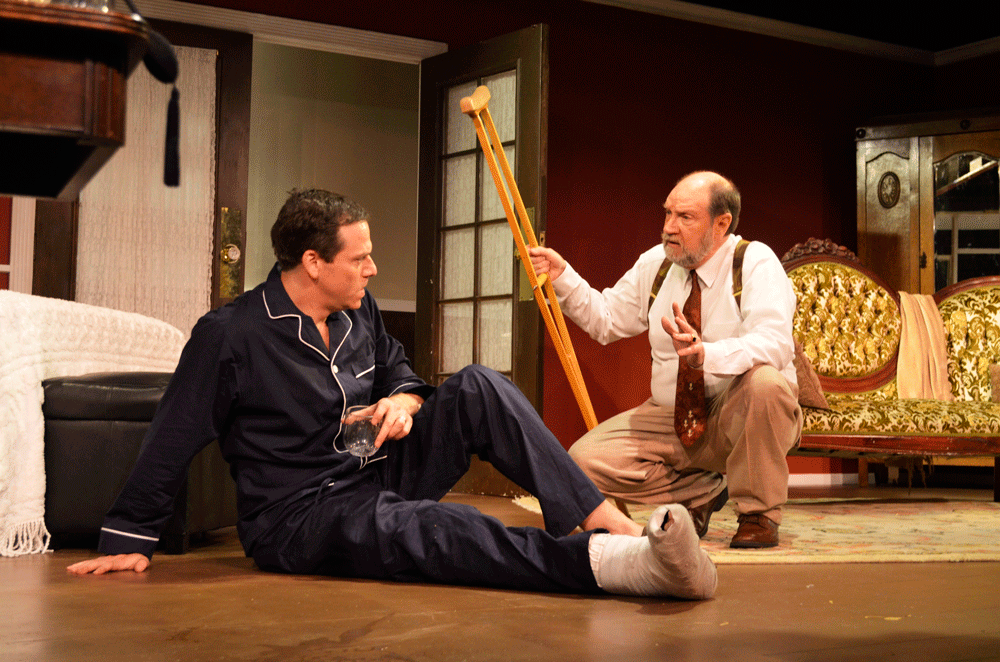
Daniel Kaemon, Kent Butler

Kent Butler accomplishes a dramatic turn in Big Daddy in his search for the truth.  He sees a lot of his son in himself, someone who is as honest as he can be.  Still, Big Daddy is looking for the truth.  And it doesn’t matter that his son had a relationship with his best friend, after all, he's had friends similar in nature, those that gave him the plantation.  Still, Big Daddy needs it, the truth, and no one is willing to offer it to him.  Butler is tremendous in the role.  The breakdown is something unexpected but worked in this production, but to what end, I’m not quite sure.

Scott Dewey, with a perpetual smile, does a grand job as Reverend Tooker and who could blame him.  He wants for the church and he is standing like a vulture over a not quite dead carcass, waiting for the inevitable.  And it’s all about his church, needing something, wanting something for the church and what better place to be.  Looking back, his performance was extremely funny!

Sometimes one wonders about the objective of a performer and what a character is doing in the show.  Case in point Bruce Nehlsen as Dr. Baugh.  And looking back, he is the one with the definitive truth that must be shared, must be concise, and point blank in a place where one can be comfortable to receive the information. Trying to give comfort and structure to an end of day scenario in a house reeking of a disorderly formality is a trying job that someone must do and why not him.  

Felicia Taylor E. does a fine job as Sookie but more could be made of her fine southern sensibilities. Still, she has a very nice presence on stage.

Much can be said about the performances of the children in this show.  Mia Banham creates a fine character in Dixie, Jacob Accardo is also very credible as Buster, and Andrew C. Grigorian does some fine work as Sonny. In the south, the children are mostly underfoot while adults want to have more than a polite conversation and in this play the children give it just the right touch, being in the moment, and providing excellent background voices and sounds.

I don’t remember seeing Lily Daugherty perform as Trixie the night I was there, and some of the smaller members of the cast were not present at curtain call.

Steve Shaw plays Tooker as well but did not perform the night I was there.

Harold Clurman talks about a strong through line in his book On Directing and in L. Flint Esquerra’s version the strong theme of “want” justifies the entire look of the show.  From the gossamer charms of Reverend Tooker to the impertinent lawyer son with the will in hand, all of the characters are greedy with want. Esquerra brings out the additional flavors of adultery, the secrets of homosexuality, and the human vanities of not being wanted at the peak of a characters sexual prime. The show needs wind to blow the Spanish moss and more wind during the storm as is typical with  southern storms.

Dialect Coach Glenda Morgan Brown does a fine job with the actors but more could be made of the accents from Mississippi, Nashville, and Memphis, which are all very different in tone and manner.

The Set Design by Chris Winfield is sublime and does not overpower the actors.  In fact the set is an actor’s delight.

Angela M. Eads is responsible for the Costume Design and each character was costumed marvelously and perfectly suited for the time.

J. Kent Inasy, Lighting Design, had a slight problem with the upstage light, specifically behind the bed, where the actors were in partial shadow – a minor glitch that will be fixed by the time you see this.

Other members of the crew are as follows:


Ceirra Burton and Pascale Gigon – Assistant Producers
Debi Tinsley – Assistant Director
Steve Shaw – Sound Design
Christian Ackerman – Videographer
Eddie Liu – Fight Choreographer
Nora Feldman – Public Relations
Dough Haverty - Art & Soul Design – Graphic Design
Drina Durazo – Program

Run! Run! Run! And take someone who lusts for you.

Through November 14, 2015

The Lonny Chapman Theatre
10900 Burbank Boulevard
North Hollywood, CA  91601

Reservations:  818-763-5990

Monday, October 12, 2015

Drunk Girl by Josefina López – Additional Plays written by Rocío Díaz and Libette Garcia

-->


By Joe Straw

When trying to reduce sexual assault, labeling all forms of sexual misconduct, including unwanted touches and sloppy kisses, as rape is alarmist and unhelpful. We need to draw distinctions between behavior that is criminal, behavior that is stupid and behavior that results from the dance of ambiguity. – Carol Tavris, social psychologist - http://www.latimes.com/opinion/op-ed/la-oe-1004-tavris-what-is-rape-20151004-story.html

Josefina López says this show is not about male bashing.  No males were bashed in the making of this production. Still, being male, one gets uncomfortable.

In the set, by Set Designer Marco De Leon, it is interesting to note the words “POWER”, in art deco-like paintings, on flats layered to form a “V” shape. Those flats are standing above a drawn symbol of a uterus, complete with the spiral shapes of fallopian tubes.

While I love Josefina Lopez’s work, I prefer her full-length plays, which may not be possible, given her busy schedule.  Still, her vignettes are a tasty treat on this night.    
One waits for the main course on another day.  

Casa 0101 Theater presents Drunk Girl written by Josefina López, additional plays written by Rocío Díaz and Libette Garcia, directed by Claudia Duran, Elvia Susana Rubalcava, María G. Martínez and produced by Josefina López, Claudia Duran, Lindsey Haley through October 18, 2015.

This production is brutally honest in its presentation of rape. López’s intention was to make the reference loud and clear. Yet the pain and destruction caused by rape may be more powerfully presented using subtlety and nuance. In a theatrical production, frequently “less is more”, and that wins the theatrical day.

Still, despite the seriousness of the subject matter, the show had funny moments, with some fine actors working on their craft. One can applaud Casa 0101 for giving Latinos the forum to act, write, and direct.  And I admit that I go to these performances to see the small gems.

Red Flag Game Show by Josefina López and directed by Claudia Duran is about Apa (Henry Aceves Madrid) and his daughter Teenage Girl (Maria Villa) who wants to date boys.  Apa doesn’t think she is ready but agrees to let her date only if she wins a TV game show where she will need to buzz in to guess the various types of men: stalkers, sociopaths, and serial killers.   (TV these days.)  

Asking For It by Josefina López and directed by Elvia Susana Rubalcava finds a couple of men hanging out in the park and throwing out lewd remarks to women running in the park. Nobody wins in this unpleasant exchange between strangers.

Stick-Her by Josefina López and directed by María G. Martínez.  Stick-Her takes sandwich boards and personal post it notes to a new level. During her night of salsa, after having too much to drink, a woman gets drunk plastered with ugly signs on her back saying “Warning I’m drunk…” or “I have herpes” so men won’t take advantage of her. Nice friends.

Alex, The Self Defense Instructor by Josefina López and directed by María G. Martínez finds Alex (Rosa Navarrete), a self defense instructor, who has been arrested for fighting, defending herself, and then having to explain why she did what she did.    

Unlucky Man by Josefina López and directed by Claudia Duran is the story of John (Alex “Alpharoah” Alfaro) who misinterprets signals from a sexual partner and later finds himself in prison. And while he is there he tells someone what it is liked being raped in prison.    

I Want You by Josefina López and directed by Claudia Duran is the story of three exotic dancers—how they feel about dancing, being in control of the men on the dance floor, and wanting to be sexy, but not necessarily wanting to have sex.

Can Finally Laugh About It by Josefina López and directed by María G. Martínez is the story of a stand up comedian Altagracias (Jasia Topete) doing her set at a comedy club when her story of her rape becomes uncomfortable and then a heavily padded owner (Henry Aceves Madrid) breaks it up and gets her off the stage but not before she makes her point.  

Second Chance by Josefina López and directed by Claudia Duran is the story of self-defense instructor, Mr. Black (Samuel Solorio) and Shy Female Student (Maia Villa) who is asked to come back, after hours, to get a second chance to pass the self-defense test.  

Pink Scars by Rocío Díaz and directed by Gina Median is a play about three women and their stories of being raped at various ages in their life.

Lolita Corazón by Josefina López and directed by Claudia Duran is a story with a lot of depth and poignancy. Dolores (Rosa Lisbeth Navarrete) is at a pharmacy to have a prescription filled for a female contraceptive.  She is one woman, with two different personalities, Dolores is cautious and her other personality, Lolita (Maia Villa), is outgoing and fearless; yet both are the same woman.


A Real Man by Josefina López and directed by María Martínez is one that I especially enjoyed.  Nacho (Samuel Solorio) plays a man giving a talk about being a real man, finding the answers that make it so, and breaking down in the process. Solonio does some terrific work in this play that doesn’t have a strong finale.  

Life Is Not A Fairy Tale by Josefina López and directed by Elvia Susana Rubalcava is another wonderful story of a girl who wants to go out dancing (Jasia Topete) and her mother (Juanita Gina Medina) who tries to talk her out of it. The mother shares her story about the time when she has the same desires with a disastrous outcome.  Medina and Topete give terrific turns as mother and daughter with a surprising ending.

Stand Up for Women by Josefina López and directed by María G. Martinez is the story of students and Professor Avila (Juanita Gina Medina) who lectures on rape and how women are controlled.


Devil Insider Her by Josefina López and directed by Elvia Susana Rubalcava is one I found absolutely fascinating.  Looking like an SNL skit, this is a story about three women in a bar who cannot stop talking about their one friend who embarrassed them the night before after she had a drink.  Debbie (Melissa Perl) then joins them and apologizes to everyone, well, not really, as her apology is a vacuous wordy stare, and to no one in particular. And then, after the one drink, she behaves much worse, worse than how the others described.  Think feeding Gremlins after midnight. Debbie is like Dr. Jekyll and Mrs. Hyde and men had better hold on.  The actors’ work is stylized and the play was a joy to watch.

Drunk Girl by Lisbette Garcia and directed by Claudia Duran is the story of Lucia (Melissa Perl) sharing at an AA meeting about how she got to this moment in time.

Yes!  Let’s Have Sex! By Josefina López, created by the Ensemble, and directed by Claudia Duran is a mishmash of ideas from the cast including the “Bill Cosby” Jello bit on video interestingly performed by Henry Kelly Alexander (who also was in a number of other skits during the night). Alexander has a nice stage presence.

All through the night and during the scene changes, the characters came acting out as if they were in various stages of inebriation.  One is not sure why the director did this or what lessons were to be learned.  Some were funny movements on and off stage, yet the point should have been clearer.

Ideally, it is probably a better idea to stay sober, and to bring a friend, and or a designated driver.   

Alex “Alpharoah” Alfaro has some nice moments, but needs to do more work in character and backstory to add to the characters’ depth.  

Henry Alexander Kelly has a good look and I can see him doing Saturday Night Live given more work and character study.  I saw some this in the Cosby skit and Devil Insider Her.

Henry Aceves Madrid is always a pleasure to watch.  I’m not sure about his padded outfit or his voice in Can Laugh About It that does not ring true.   

Jasia Topete is an actor that can do many things and she is surprising in her roles on stage.  She is a fresh face and everyone loves fresh faces.

Juanita Gina Medina really gives her all to the various scenes she is in.

Maia Villa has a wonderful presence and expressive eyes, and does some nice work in her scenes.

Melissa Perl is outstanding in the Devil Inside Her and comical in Stick-Her.  She is thin, with a wry sense of humor, and has expressive green eyes.  She also has a lovely voice. One can only imagine watching her do other fantastic things.

Rosa Lisbeth Navarrete has an unassuming character as Dolores in Lolita Corazón but is outstanding in the role.

Samuel Solorio does some outstanding work throughout the various pieces he is in but he also does the small things when he is not in the scenes that bring a lot of life to a character.  These are the intangible things that make an actor shine on stage.

Other members of the production team are as follows:

Wendy Castro – Assistant Director
Sophia Sanchez – Stage Manager
Estibaliz Giron – Assistant Stage Managers
Sohail e. Najafi – Technical Director
Marco De Leon – Set Design
Rafael O. Calerón – Set Builder Assistant
Joshua Cuellar – Lighting Design
Jorge Villanueva – Light Board Operator
Abel Alvarado – Costume Designer
Julius Bronola – Assistant Costume Designer
Vincent A. Sanchez – Sound Designer & Projections
Steve Moyer Public Relations – Press Representative
Ed Krieger – Photography
Soap Studio, Inc. – Graphic Design

Run!  Have fun! And take a designator driver/body guard. 

Reservations:  323-263-7684
email tickets: tickets@casa0101.org
buy online:  www.casa0101.org

Tuesday, October 6, 2015

No Exit by Jean Paul Sartre


Carolyn Hennesy (l.), Erica Edd, Rick Friesen, Alan Naggar, Barbara Ann Howard, Kristen Egermeier, Matt Fowler, Austin Musick - Photo by Kent Minault


By Joe Straw

He owed me $138.01 and I couldn’t find him.  He didn’t answer my calls and that wasn’t like him.  Not paying me, that was like him, but not answering the proverbial door, well, he’s never done that. For two years he was nowhere to be found, then, as one does with a lost cause, I wrote him and the money off, when unexpectedly, he walked into my office. 

I found out that, during those two years, he had died. Well, not completely.  Five heart attacks couldn’t kill him, completely.

And in his smiling Middle Eastern accent: “I was dead too - and I want you to know there was no white light, no one to come get me from the other side, there was nothing but nothing, done, finished, quiet, peace.” – Narrator.

InterACTtheatre company presents No Exit, a revolutionary play by Jean Paul Sartre, directed by Ken Minault, and produced by Michele Rose Naggar from September 17 to November 1, 2015 at Oh My Ribs! Theatre, 6468 Santa Monica Blvd., Hollywood, California.

If you believe, don’t believe, think you want to believe, or don’t want to believe, you should run to see this show. Come over to the other side, the side you think is there and look into their three walls, reside in the fourth, and watch this remarkable show.

This show happens in small earthly increments.

First of all, there is a little bit of theatrics when one arrives outside the theatre.  On this night, a couple stick their heads out, alá the Marx Brothers, look at me, and inform me they’ll be opening soon, slide, and bolt lock the door.   

And I’m left there standing along Santa Monica Boulevard breathing in deadly VW exhaust fumes, waiting to expire, when five minutes before curtain, they allowed us entrance.   

And before I enter the theatre, someone interrupts me and asks me to sign a form:

Indenture of Retainer in Reference to a Soul
(This is a Standard Contract – You don’t have to read it.)

“Standard.” Ha!  Only in Hollywood.

I signed it and then had second thoughts, big thoughts.

The Valet (Rick Friesen) slides the door open of this mausoleum and with his powerful voice scares the bejesus out of me as he announces my name.  It is all rather comedic and ghastly.  Couples are treated semi-respectfully and Valet moves one step further to disparage the single patron, no he shames them.  (Take someone with you.)   

After all are seated, the play begins.

In my mind, No Exit is an illusion, of characters presenting a false front of imaginings and impressions in a place of espial, under the watchful eye of a higher power.

So, as a means of describing the play, I will offer an observation in the voice of the character you don’t see, the Valet’s Uncle. The bold quotes are from the play.

“Valet’s eternity starts with a grand beginning and Valet didn’t let me down.  It is the proverbial stake in the heart, and it is also the way in, with No Exit. You may applaud.

“I’m Joseph Garcin, journalist and man of letters by profession.” - Garcin

Despite his brave front, Joseph Garcin (Matt Fowler) is a coward; there is no mistake about that.  If I could engrave that one thing into your ineffectual wandering mind, it is that Garcin is a coward. And that is all.  Not really all, there is a little more. 

Garcin was caught running away from a fight, an important fight.  They found him on the train, seated innocently.  The soldiers politely took him off the train and executed him for being a deserter.  Twelve bullets raced toward that coward’s heart and found a way through his abrigo, bleeding where cowards bleed, gasping for breath, face down, and in the dirt.

For Garcin, it was his peripeteia. Pity.

Garcin is here now, in my little playpen, some call it hell.  There are other names. This is not what he imagined it to be but they never do.  They expect instruments of torture, flames, and red-hot pincers—funny.  

And Garcin expects that he is here because of something he has done and it doesn’t have anything to do with the bullets. I wonder what that could be? The others will enervate his smug confidence once they arrive.

The Valet is my nephew.  He adores that name. Valet introduces Garcin into the room, with the nasty Second Empire furniture motif, and a male bronze, complete with a raging bulge, something that the ever-so-masculine-coward Garcin would like and maybe one of the others that will follow.   

I took special care to provide a room filled with articles that are unmovable, including the bronze, and everything is precisely where it should be, angles and all.  

Garcin and Valet don’t get along, just as I expected.  Garcin has an air about him.  That won’t last long.

My nephew doesn’t have his eyelids.  They have atrophied and now he’s left them in a forgotten place.

This place is like that.  

Garcin has not gotten the hint about the room.

“I shall never sleep again. But, then how shall I endure my own company?” – Garcin

There is no way out.  Garcin may ring for the Valet, but hell is capricious.  Funny to hear Garcin inquire of what lies beyond the door.

“There’s a passage.” – Valet

“And at the end of the passage?” – Garcin

“There’s more room, more passages, and stairs.” – Valet

“And what lies beyond them?” –

“That’s all.” – Valet

Not a good start for the honeymoon accommodations.  No books, no windows, only a paper-knife, and I laugh every time I think about it.

One can plainly see that when Garcin is left alone, the coward peeks his head out, like the turtlehead coming out of the shell.  Oh really, the paroxysm of necessity, the pounding on the door is so, unnecessary. And not the least bit provocative.

My dear Valet has to provide some comfort, it’s part of his job, so he opens the door to give the room an extra added flavor, Inez Serrano (Carolyn Hennesy), a fashionable lesbian postal clerk.  Oh! How I detest that word, lesbian.  How about “A lover who wings another way”

“…we should make a point of being extremely courteous to each other.  That will ease the situation for us both.” – Garcin

“I’m not polite.” – Inez

“Then I must be polite for two.” – Garcin

Not only a coward but a bore as well with his weasel mouth for which Inez is not particularly fond of, and she tells him that, because that’s the type of woman she is, straightforward, to the point, and very nasty to his contradictory masculinity.

It is only when Estelle Rigault (Austin Musick) joins that Inez tempers her flair. Inez is intoxicated with the female form, her dress, and those delicate hands, which are carefully looked after.  But Estelle is perplexed and it is up to Inez to help her.   

“Estelle!” – Inez

“Yes?” – Estelle

“What have your done? I mean, why have they sent you here? – Inez

“That’s just it.  I haven’t a notion, not the foggiest.  In fact, I’m wondering if there hasn’t been some ghastly mistake.” – Estelle  

Oh she knows but she is having a hard time coming to terms. This is turning out as much fun as I had planned.”

(I’m told that I should tell you that I’ve switched voices.  Thank you for your indulgence.)

I’ve seen No Exit in multiple forms and on different occasions.  By all means, there is no wrong or right way to execute the play.  One might think there are better choices, or creatively, a better fit.  Certainly, this particular production has some very nice things in it and Kent Minault, the director, presents the piece as a comedy (I think it is a comedy.) with just the right touch of frightening elements for those in need of that form of drama. On this particular night, moments were missed that will probably come together when you see it. But still, this is an outstanding night of theatre.

Matt Fowler as Garcin brings a lot of humor to the role. Garcin is afraid of his own shadow, certainly afraid of this new beginning, despite his brave front. And in the play, this weakness defines the character and movement must be made with that in mind.  I didn’t see much of that in Fowler’s character.  In his version, Garcin’s brave soul wants to avoid the conflict by making it an introspective process.  He is not showing us the fear in his character which one must have in order to realize the truth and ultimately his salvation.  In the end, we never get his full story.  It’s part of his work in progress for salvation.  Still, this is a fine role for Fowler and he does remarkably well.

Carolyn Hennesy plays Inez very delicately and is surprising in her manner and execution.  Hennesy is very calm and relaxed, and she lets the moments play to great satisfaction. There is a question about how much she wants her female companion in hell.  Does it go far enough in terms of want? She does everything in order to get the woman to wing her way.  Also, Inez is not polite.  The song she sings is about people being executed did not come off as an instigating dig in Garcin’s direction. It was beautifully sung but did not hit the mark with the intention it deserved.  Hennesy came out during curtain call and politely curtsied but more was in her look, that things did not go accordingly as planned, that it was an off night.  But this was Hennesy’s night.  The work was excellent and almost flawless. (Despite my ramblings.)

Austin Musick is Estelle and there were some fine moments in her performance.  But the role really requires Estelle to be dripping with want, especially for a man, any man will do, cowards included. This Estelle conveys a sinister debutante, a poor southern girl married into wealth, rather than a woman who uses her beauty to get what she wants, when she wants it.  But, her choices, although sometimes interesting, kept her in the middle of the road.  One would want to see her fighting off the woman one moment, and pulling the man to her every chance she got, despite his cowardly handicap.

Regarding Kent Minault’s direction the one thing that caught my attention was the lipstick scene, which did not covey the meaning of want but portrayed the scene as someone moistening her lips.  Also, on the other side of the lipstick, was a woman who desperately wants Estelle and getting nowhere.  This scene defines the relationship for all three, of three individuals stuck in hell, and not being able to get what they want for eternity. 

Also, in the character’s want of salvation, and striving for the truth to move on, to eventually get out, none are shocked to learn the true nature of the other’s crimes. No Exits suggest they are trying to get out but won’t because they can never fully come clean. Their stories are very shaky and suspect and also, they are not reliable reporters of the truth.   

Alternate cast members who did not perform the night I was there include Erica Edd (Inez), Kristen Egermeier (Estelle), Barbara Ann Howard (Valet), and Alan Naggar (Valet).

Alan Naggar served as the Executive Producer.

Michele Rose Naggar was also a Producer and the Costume Designer.

Kurtis Bedford, Set Designer, displays appropriate skills in this very workable small intimate theatre.

Carol Doehring is the Lighting Designer.

Jonathan Sacks – Musical Direction
Ari Radousky – Stage Manager
Aaron Francis – Stage Manager
Philip Sokoloff – Publicist

Run!  Run!  And take someone who has seen No Exit a number of times if for no other reason than to get another perspective of hell.  

Sunday, September 27, 2015

In Love and Warcraft by Madhuri Shekar

-->


L - R Jessica Jade Andres, Rosie Naraski, Eddie Vona, Michael Barnum and Justin H. Min - Photo Credit: M. Palma Photography
By Joe Straw

EXTENDED THROUGH OCTOBER 18, 2015!

I’m going to make about as true a statement as I can: College football and this show have what in common? Okay, that isn’t a statement but a question, and one that deserves an answer, only later. - Narrator

Artists at Play in association with The Latino Theater Company present the west coast premiere of In Love and Warcraft by Madhuri Shekar and directed by Alejandra Cisneros September 19 – October 11, 2015 at the Los Angeles Theatre Center on Spring Street in Los Angeles, California.

There are two things that make my eyes glass over quickly.  Number one is an auto enthusiast talking about auto repairs and number two is computer geeks talking about computer games.

For now let’s block off car repairs and move that aside.

So, why my interest in seeing this play? Well, there is a commonality between this show and college football. Both college football and the play feature college adults living, working and surviving.  The setting is ripe with conflict, new relationships, making silly mistakes, and learning from those mistakes.   

My reason for attending is that simple.

In Love and Warcraft, written by Madhuri Shekar and directed by Alejandra Cisneros, is a marvelous show with some very exceptional and diverse performers giving us multiple characters that marvelously inhabit their space. There are a lot of laughs and a lot of quality acting, more than you see on television these days and that’s a good thing.

It turns out that Warcraft is a real game created by Blizzard Entertainment, first released November 23, 1994, and now a franchise of video games and novels.

And now it is evolving from TV to interactive computer games, and then back to the theatre. Funny, that’s full circle, and lots of fun.  

This is a story of boy meets girl, kinda.  Girl meets another boy because boy lost girl, well sort of.  Girls dumps boy because she’s lonely, not really.  Girl hasn’t had a date in a while so girl steals already taken boy, well sort of.  Real life played like a computer game with various realities and choices. All in all, they are Avatars.

Avatar:  A graphical representation of the player’s character.  

Evie (Rosie Narasaki) and Ryan are Warcraft virtual girlfriend and boyfriend.  Evie, a college student, makes money writing love letters for other college students that haven’t learned the art of written communication.  And Ryan is an out of work young man living in his parents’ basement in San Diego, going to the top of nowhere.  

Kitty (Jessica Jade Andres), Evie’s spunky tart girlfriend, wants to breakup with her boyfriend.  Oh, it’s all for the best.  She’s ready to move on and search for another victim, boyfriend, all in the quest of fulfilling her dramatic and unquantifiable physical needs.   

Evie, ready for work, waits for Raul (Justin H. Min), so that she can write a love letter for him.  Unfortunately for Evie, Raul turns out to be the hunk she has been waiting for all of her life. 

That’s IRL (in real life), not virtual.  But never mind that, there’s work to be done. Evie is a Healer.

Healer:  Spellcasters with the power to heal other players.

Raul wants to get back with his girlfriend of two years because making up is so much fun.  So Evie, with her literary powers, composes a nice letter for him.  (Funny but I didn’t see payment exchange hands.) 

Justin H. Min, Rosie Narasaki


Later, Evie and Ryan go on a virtual date. Given the circumstances of this long distant relationship, two hours away is about as romantic as they are going to get. Also, Evie has certain physical issues.

Kitty advises Evie that her relationship with Ryan is a lose/lose situation and sending him money is not the way to show affection.  

“You could do better.” - Kitty

The next day, Raul bumps into Evie and says that he didn’t give the letter to his ex-girlfriend because “none of it was true.” And then Raul asks Evie out for a real date, not a virtual one, and Evie accepts. 

Excited Evie runs off to see her Latino gay haircutter, dresser, barber (Eddie Vona as Male).  Male, in his Spanish accent, flits over her like a fly over raw hamburger meat, making her feel the best she can be, all the while going into graphic details of his sexual conquest the night before.    

And after Evie leaves, Female (Cheryl Umaña), in her best Puerto Rican Spanish, recounts her obnoxious date, who shows up late, wearing cheap cologne, putting his hands all over her and himself, and then exploding all over her new jeans.  All this in great details while Male meekly sweeps up.  But Male doesn’t understand anything she is saying. He doesn’t speak Spanish.  Female says it’s all about being authentic.   

Later Evie has a real date with Raul. And Evie remains not interested in sex even after dating for a month.  Although Raul wants more to the relationship, he is willing to wait.

Evie thinks there is something wrong with her vagina so she visits her doctor (Cheryl Umaña) and after a lot of exploration the doctor finds…

Artists at Play (AAP) are a collective of Asian American creative professionals who curate quality theatre in Los Angeles. Truth be told, In Love and Warcraft is as fine example of a theatrical outing as you will find in Los Angeles. 

AAP is filled with exceptional talent. The production has a cast of six but with costume and character changes, it seemed like there were ten or twelve actors on stage.

Jessica Jade Andres is exceptional as Kitty and is able to take that life to extremes. Kitty is witty, oversexed, and has an extremely charming personality. Andres pulls off an amazing physical life for Kitty.

Cheryl Umaña is also exceptional playing a variety of characters.  Her Spanish is top rate and her ability to create differing characters offers this show a lot of creativity. Umaña is an amazing talent and one hopes to see more of her in future shows.

Eddie Vona, Cheryl Umaña


Eddie Vona is also excellent, especially as the barber where one is just stupefied by the things coming out of his mouth.  This small bit is a great showcase for an actor with incredible talent and the ability to create a fantastic multi-level character.

Justin H. Min is Raul the main love interest who gets himself into a lot of trouble in the end.  The character may be too nice as he waits for his companion to come around. There is more to this character, not wanting to wait, dying inside, and demonstrating humorous conflict with no bounds, while he’s waiting. Min has a great look and a very nice presence on stage. He is an actor with a natural flair and should do very well in this industry.

Michael Barnum plays Ryan.  It’s hard to see him when he is stuck on the second level looking on his computer speaking geek. But there is a special quirkiness to his character when he appears on the first level and he does some fine work.

Rosie Narasaki played Evie on the night I was there.  She did some interesting work but she needs to find the core of the character.  Her character is caught between two worlds, the virtual and the real life world.  In the virtual world, she can be anyone, do anything, and be as sexual as she wants to be.  But in the real world, she thinks something is wrong with her sexually and her ability to connect with other living beings.  So much so, that she visits a doctor to find out what is wrong with her parts.  Never once does she consider counseling.  Naytheless, Narasaki must put a definitive stamp on her virtual world, and then deeply explore her real life hang-ups via the inner and physical life of the character. Still, this is not a bad job.

Other members in the cast who did not perform the night I was there are Anita Kalathara (Evie), Ruffy Landayan (Male), Jake Matthews (Raul, Ryan) and Brenda Perez (Kitty, Female).

Alejandra Cisneros, the Director, has an impressive list of actors in Warcraft and she makes full use of the two-level stage.  At times, the show plays like a teen sitcom, but moves beyond with the adult humor. It would be nice to find a way to get the character Ryan out of the rafters and on to the playing floor so that we can make more of his performance.  For the most part, the virtual world was handled in the manner of a real world situation and one thinks there should be a clear distinction. The manner of how Evie feels in a real world situation versus a virtual world should be clearer.   We see that late in the show, but by then it is too late. That note aside, Cisneros does a fine job.

Madhuri Shekar, Playwright, has written an exceptional play. In reality, the virtual world has only tapped a small part of our collective imagination but in Warcraft, Shekar manages to show us how much crazier real life is as opposed to a virtual life.  That said, Warcraft is an exceptional idea that can even go further in its distinction between real and virtual life.  Also, and just a note about the play, it is unclear why two characters in the show are named “Male” and “Female”. All characters in a professional outing should have names. That aside, the writing is superior and the night was exciting.

Art Betanzos, Set Designer, provides a very workable set very similar to teen sitcoms on television.

Magdalena Guillen, Costume Designer, along with Estrella Fernandez, Asst. Costume Designer, does fantastic work especially with the Warcraft costumes.

Other members of the crew are as follows:

Anthony Aguilar – Lighting Designer
Iris Zacarias – Sound Designer
Sasha Monge – Property Master, Asst. Set Designer
Jonathan Castanien – Stage Manager
Brandon Cheng – Production Manager
Chloe Haack – Asst. Stage Manager
Julia Cho – Producing Artistic Leader
Stefanie Lau – Producing Artistic Leader
Marie-Reine Velez – Producing Artistic Leader
Nicholas Pilapil – Producer

Members of the LATC crew are as follows:
Jose Luis Valenzuela – Artistic Director
Lori Zimmerman – Interim Gereral Manager
Dr. Chantal Rodriguez – Programming Director

Run! Run! Run!  And take someone who loves UCLA football!

Thursday, September 24, 2015

Mojada A Medea in Los Angeles – A New Adaptation by Luis Alfaro

-->
Justin Huen, Sabina Zuniga Varela


By Joe Straw

“Thy words be gentle:  but I fear me yet
Lest even now there creep some wickedness
Deep within thee.” – Creon – Euripides’s Medea

“Oh, I have tried so many thoughts of murder to my turn,
I know not which best likes me.  Shall I burn
Their house with fire?  Or stealing past unseen
To Jason’s bed – I have a blade made keen
For that-stab, breast to breast, that wedded pair?...

Nay,
I love the old way best, the simple way
Of poison, where we too are strong as men.” – Medea - Euripides’s Medea

Mojada A Medea in Los Angeles, a new adaptation by Luis Alfaro and directed by Jessica Kubzansky, is being performed through October 3, 2015 at the picturesque Barbara and Lawrence Fleischman Theater at the Getty Villa.  The Theatre @ Boston Court marvelously produces this show. 

Mojada is a perfect show for this venue given the 44,000 Greek, Roman, and Etruscan antiquities that inhabit the museum.  The open-air amphitheater (with cushions for seating) is how one would expect to see a Greek play and, in an imagined vision, of how the Greeks saw Euripides’s Medea, when first produced in 431 BCE in Athens, Greece.

Luis Alfaro’s Mojada A Medea in Los Angeles stands alone in its exquisite beauty. Alfaro’s adaptation is remarkable in the manner of its flow and ebb; the method in which exhausted souls speak a profound truth, of survival, of seeking a better life, and then pushing that life to the edge of a hideous precipice.  In short, Alfaro’s adaptation is a different Medea as well as one that stands uniquely on its own merits. 

This is a tragic story of the end of a relationship.  

Tita (VIVIS) slaps the leaves, to the sounds of the blended noises, the false gossipy whispers, which are the backdrop rumblings and clatters of living souls surviving in Boyle Heights.  And in her indigenous language, Tita places a protective shield to the corners of their home against those forces known and unknown.  

Living in Boyle Heights is almost a fantasy for this family and one that defies comprehension. Dreamlike, the house floats in out of nowhere, carried on spirit wheels, mightily pushed by the indigenous people who anchor it to the terra firma while various plants propagate on the porch. 

And Medea (Sabina Zuniga Varela) methodically rolls her sewing machine to her special place, just off the porch, and focuses her sights on the right color of thread.  

One more thing, Medea is not moving far from home.

“Hason’s dream was to come here.” – Medea

It is a dream of bitterest contradictions, of her husband, Hason (Justin Huen), who manages to find work late at night, most nights, and comes home infrequently.  When he does come home, he drinks beer, spits on the ground in polite company, and kicks the soccer ball down the street for his son, Acan (Quinn Marquez), to chase. It is how all Americans behave, he tells himself, in a selfish act of assimilation.

But, despite the grumblings, life appears happy, in this home, a family, complete with the ever present and annoying servant, Tita, someone who gives a humorous respite to the daily grind of surviving in Boyle Heights, doing the dishes and bringing them beer.  

Medea, the artist, an independent contractor, receives $8.00 for each item she sews that is then sold for $120.00 at Bloomindales.  Even with both working, there’s not enough to go around and adequately support the family.

Not while Hason is out and about most nights.  

That aside, on this day, Hason suggests they go for a family outing to the Santa Monica Pier.  Medea says there’s too much work, gets sick and goes inside.

“Hason did not come home last night.” – Tita

Leave it to Tita and her outspoken thoughts to stir up trouble between Medea and Hason.

Moving away, Tita grabs the machete, an augury, foreshadowing events to be played out, but for now she trims the banana plant.  

A short while later, Josefina (Zilah Mendoza) seductively blows into this family like an unwanted boa – offering more than just pan dulce – in exchange for confabulation, juicy gossip, and a new dress.

“I know Hanson…Is he a good lover?” – Josie

Josefina is very provocative and Medea is curious about the things Hason tells other women on the street. But Josefina says she has a husband, he works in the field in Oregon, and she longs for her own prodigy.

Initially, Medea sees Josefina, with her fine figure, as a threat to her family.  That threat is relieved when Josefina appeals to Medea’s sewing nature to make her a new dress so that a newly Americanized “Josie” can be reintroduce to her husband, enticing him into bed, and becoming pregnant herself.

“Tita is a curandera, she can help.” – Medea

Josie steps onto a box in the middle of the yard to be measured. And while this is happening, Tita takes three leaves and medicinally places them over the various erogenous zones of her body.   

Later, and in the quiet moments, Medea silently broods about the events of the day and waits for Hason to come home.  She takes out a blanket and entices Hason to make love with her in the front yard. Hason, confused, suddenly become agreeable until Medea suddenly stops and says she can’t.

Hason understands this thing between them.

“Armida gave me another promotion.  I work in the office with her.” – Hason

Medea is slightly curious about the developing relationship between them but Hason tells her that she should be grateful since Armida (Marlene Forte) is letting them stay in their house for free.  

It’s a grand place considering where they came from four years earlier.

L - R Justin Huen, Quinn Marquez, Sabina Zuniga Varela, VIVIS


And so we travel to their journey four years earlier, as Tita recounts fleeing Michoacán to Boyle Heights in the back of a truck, where at times they were unable to breath.  The journey was difficult and at one point the truck was held up at gunpoint.

And while Hason had a gun pointed to his head, Medea and another young woman were taken off the truck and raped.  

The Getty Villa is the perfect place to see this play and, aside from the heat on this particular night, the night was as enjoyable as any night of theatre I can remember.

That said, Alfaro’s adaptation is night to Euripides’s day and comparisons must be made. And, I have some thoughts, slight tidbits, off the cuff comments about the play, the comparisons, and the actors.

Alfaro’s work is beautiful and there are interesting distinctions between his work and Euripides’ play. For example, in Euripides’ Medea, Medea is caught in the circumstances of being a woman, a sorceress at that, who is cast aside and then projected as being evil. Her dialogue suggests such and the manner in which she conducts herself is not becoming of someone who has all of her wits about her. It is a role that justifies a stronger physical Medea.

Alfaro’s Medea is unable to leave the house, suffering from a type of agoraphobia. She is timid, not forceful, and we are led to believe that this might be because of the rape when in fact it is something deeper.  There is a stronger inner dialogue moving in this Medea trying to make sense of all that is happening around her. 

In Alfaro’s version, the rape scene works against the strength of both Medea and Hason.  Certainly one is led to believe that Medea is now extremely fragile and terrified due to the rape and Hason is emasculated from having to let an armed bandits take his wife.  

And it may have been Alfaro’s intention to not make the characters resilient as they are in Euripides’s Medea where Medea is forcefully strong in her ways and Jason (adventurous, strong, and of the Argonauts fame) is strong in his manner, thus making for an ending that is grander in amplitude.    

Instead, since both characters are fragile, the events of the dramatic ending are lessened; the tragedy may not be as great and they are the victims once again by the manner of their position and circumstances.

In Alfaro’s Mojada, we do not see Medea thinking out loud on stage, calling for desperate measures and action as we do in Euripides’ Medea.  The moments in Mojada are nuanced and profound in subtle ways.

Medea is wronged repeatedly and one would like to see the dramatic moments accumulate in the character, emotional and physically into a frenzied state of rage. The inner dialogue is stronger, but that needs a physical accompaniment especially for the ending because Medea must get some satisfaction for what she has done, in whatever form it takes, but there was little in the way of a physical action, before the leaves, and before the final curtain. 

Nevertheless, it was a grand night for director Jessica Kubzansky’s presentation that manages to capture the dramatic essence of Medea guiding the characters through their miserable indignities to capture a truth. The loudest audible gasp of the night did not come from the brutal scenes but from a word, simply spoken, that collapses a home into a crumbling mass that was once a family. And that is a true testament to Kubzansky’s work.  

VIVIS as Tita give us a grand performance as the non-obsequious servant/mother/nurse to Medea.  Her characterization is flawless and her humor is exquisite.

Justin Huen plays Hason and is probably one of the hardest working actor in Los Angeles (everywhere I go, there he is). That said, Huen’s Hason is not different from the other roles I’ve seen him in. They are well-performed variations of the same character.  This characterization is weakened by the play’s tragic events of four years ago and Huen needs to find ways to give the character strength.  More can be added to the character without taking away from this fine performance.

Sabina Zuniga Varela plays Medea, a mother and homemaker, who is hesitant to stray too far from her house.   In this version, Medea hides her mystery well – coming out to show her true colors at the end of the play.  Medea is concerned about her husband’s philandering ways but doesn’t do much to keep him. Only when the marriage is over does she step into opprobrious actions that are beyond reason. Varela’s Medea has her faculties about herself.  We do not see the feverish agitation in her behavior from those events leading to the complete disillusion of their union. And for some reason, I think we need that.

Quinn Marques does a fine comic turn as Acan, Medea’s and Hanson’s son.

Zilah Mendoza is perfect as Josefina, the pan dulce lady, who carefully watches her Boyle Heights neighbors including the men with wandering eyes who visit her stand.  Despite that, she says she only has eyes for her husband.  Not satisfied with her shibboleth, the indigenous dress of her native land, she enlists Medea to make her a new dress, one that will keep her husband home and get her pregnant. Unfortunately, she gets mixed up with the wrong people and when she finally finds out who Medea is she should run, absquatulate into the nether region of Boyle Heights, away rather than casually walk away as she did.  Still, it was a very impressive performance.  

L - R Marlene Forte, VIVIS


Marlene Forte brings the right amount of vivaciousness to the character Armida.  She lives a secret, a conflict that tears her apart in the telling of the secret.  And as she marches upstage in the beautiful dress Medea has made for her we should see an inkling of things that come. Forte gives a subtle yet marvelous performance.

Other member of the cast that I did not see perform the night I was there were; Anthony Gonzalez (Acan), Denise Blasor (Tita/Armida understudy), Presciliana Esparolini (Medea/Josefina understudy) and Adrian Gonzalez (Hason understudy).

The fine people who make up the marvelous crew are as follows:

Jaclyn Kalkhurst – Stage Manager
Alyssa Escalante – Assistant Stage Manager
Efren Delgadillo, Jr. – Scenic Designer/Technical Director
Raquel Barreto – Costume Design
Ben Zamora – Lighting Design
Bruno Louchouarn – Sound Design
Christopher Scott Murillo – Properties Design
Cheryl Rizzo - Production Manager
Cat Sowa - Assistant Production Manager
Rachel Clinkscales - Assistant Costume Designer
Courtney Buchan - Assistant Director
Ellen L. Sandor - Wardrobe
Bobby Gutierrez - Running Crew
 
The members of The Barbara and Lawrence Fleischman Theater Staff make everyone feel at home.  Some of the names mentioned in the program are as follows:

Laurel Kishi – Performing Arts Manager
Ralph Flores – Project Specialist
Anna Woo – Project Coordinator
Mary Louise Hart – Dramaturge
Shelby Brown – Education Specialist
Adrienne Wohleen, Paradigm Shift Worldwide – Technical Coordinator
Steph Dirden, Heather Alvear, Michael Easley, and Bill King – Technical Production
Visitor Services Department – House Management
Diana Sanchez Martinez – Public Programs Intern

Run! Run! Run! And take someone who wants to have the best time of their life.